ACID, SOLID, and Common Design Patterns: A Software Design Reference
Contents — Part 25 of 26: How These Three Layers Connect
- 1.Overview
- 2.Atomicity: All-or-Nothing Transactions
- 3.Consistency: Valid States Only
- 4.Isolation and the Concurrency Spectrum
- 5.Durability: Write-Ahead Logs and Crash Recovery
- 6.Putting ACID Together: A Transactional Transfer in Code
- 7.Single Responsibility Principle
- 8.Open/Closed Principle
- 9.Liskov Substitution Principle
- 10.Interface Segregation Principle
- 11.Dependency Inversion Principle
- 12.SOLID Applied: Refactoring a Violation-Riddled Class
- 13.Creational Patterns: Factory Method and Abstract Factory
- 14.Creational Patterns: Builder and Prototype
- 15.Creational Patterns: Singleton and Its Pitfalls
- 16.Structural Patterns: Adapter and Facade
- 17.Structural Patterns: Decorator
- 18.Structural Patterns: Repository and Unit of Work
- 19.Behavioral Patterns: Strategy
- 20.Behavioral Patterns: Observer
- 21.Behavioral Patterns: Command
- 22.Behavioral Patterns: Chain of Responsibility and Iterator
- 23.Behavioral Patterns: Visitor
- 24.Composition Over Inheritance
- 25.How These Three Layers Connect
- 26.Common Mistakes and Interview Traps
How These Three Layers Connect
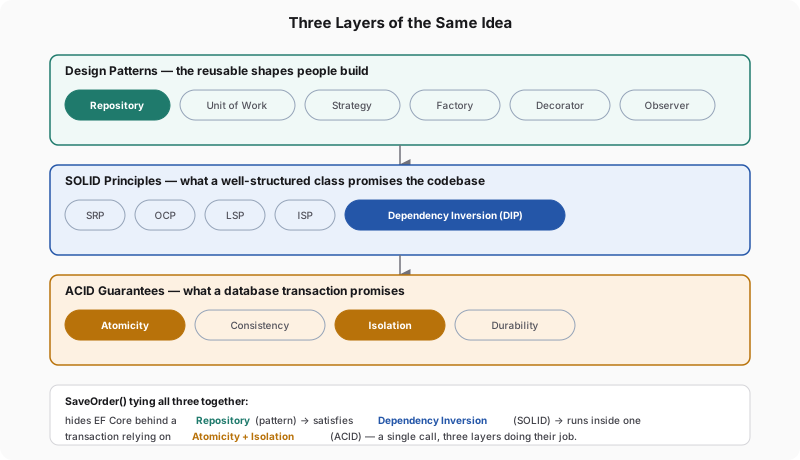
A single concrete example ties every layer covered in this reference together. A Repository (a Structural pattern) hides EF Core behind an IOrderRepository interface, satisfying Dependency Inversion (a SOLID principle), which is what lets OrderService be unit tested against a fake repository with zero real database involved. When that repository's SaveOrder() actually runs against a real database, it executes inside a single transaction relying on Atomicity (so a crash mid-save can't leave a half-written order) and an appropriate Isolation level (so a concurrent read of that order never sees it half-written either) — two ACID guarantees the calling code never has to implement itself, only invoke correctly. Design patterns are the shapes; SOLID is why those shapes were chosen instead of simpler-looking alternatives; ACID is the floor the database gives every one of those transactions to stand on.